
Tracks and Progress
How learning tracks organize your Rust journey
On this page
Tracks and Progress
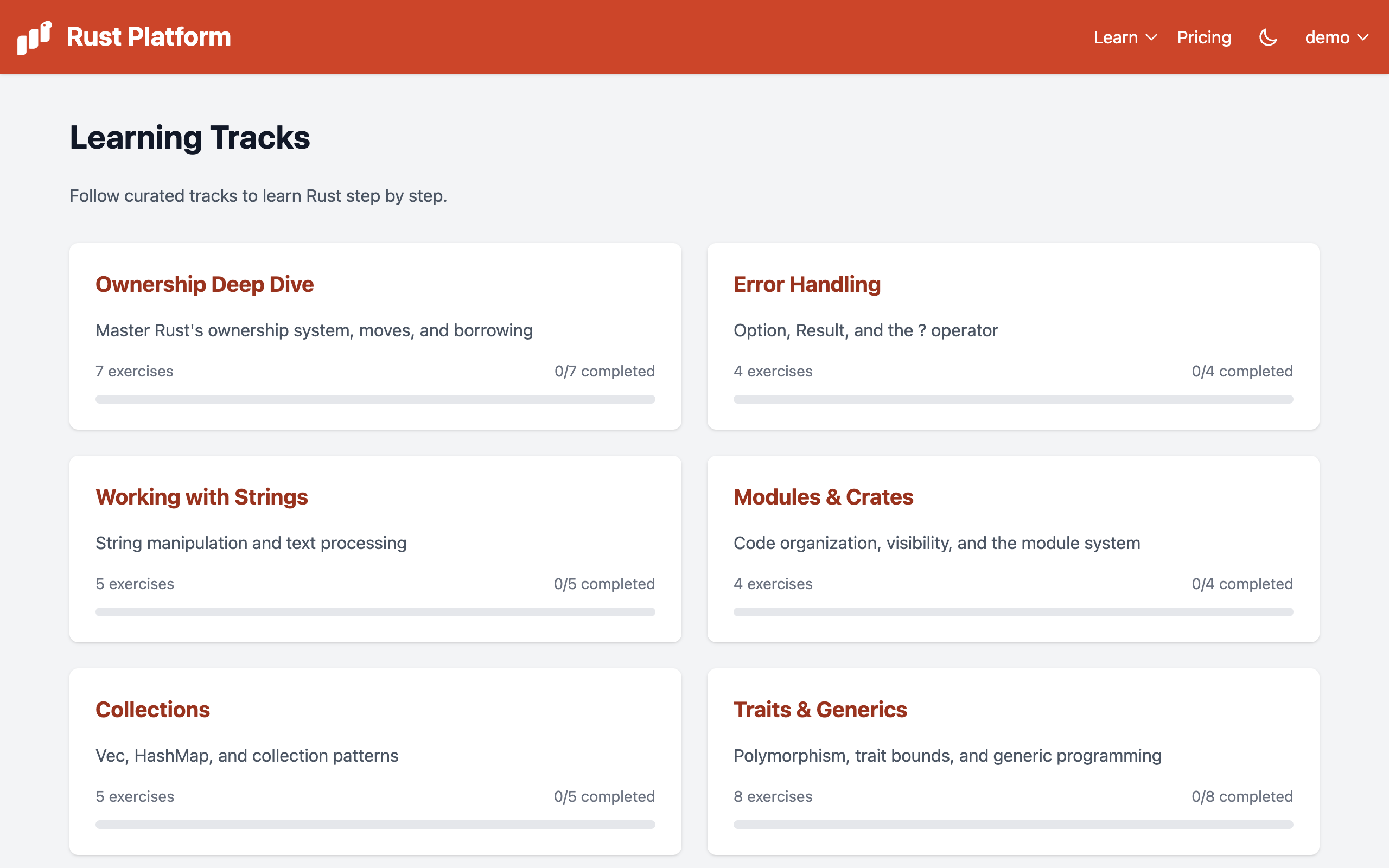
Tracks are structured learning paths that group related exercises into a logical sequence. They're the recommended way to learn on the platform.
Available Tracks
The platform currently offers these tracks:
- Intro to Rust — Rust fundamentals
- Ownership Deep Dive — Rust's ownership system, moves, and borrowing
- Error Handling — Option, Result, and the ? operator
- Working with Strings — String manipulation and text processing
- Modules & Crates — Code organization, visibility, and the module system
- Collections — Vec, HashMap, and collection patterns
- Traits & Generics — Polymorphism, trait bounds, and generic programming
- Iterators & Closures — Functional programming patterns in Rust
- Algorithms — Mathematical and algorithmic exercises
Each track has a difficulty progression, starting with easier concepts and building to more challenging problems.
Track Progress
When you're logged in, each track shows a progress bar indicating how many exercises you've completed. You can see this on:
- The Tracks page (Learn > Tracks)
- Individual track detail pages
Navigating Within a Track
On the track detail page, exercises are listed in their recommended order. Each exercise shows:
- Its title and difficulty level
- Whether you've completed it
- A link to start or continue working on it
When viewing an exercise, you'll see Previous and Next navigation links to move between exercises in the same track without going back to the track listing.
Beyond Tracks
You can also browse all exercises outside of tracks:
- All Exercises — a flat list of every exercise on the platform
- By Tag — find exercises by topic (e.g., "strings", "error-handling", "cohort-w1", latter being exercises related to our Intro Rust cohort)
- By Author — see exercises by a specific contributor